As an Amazon Associate this site earns from qualifying purchases.
Quick Picks
| Paddle | Core | Face material | Spec-sheet standout | Link |
|---|---|---|---|---|
| JOJOLEMON Pickleball Paddles Featuring a Raw Carbon Fiber Paddle Face and 16mm Power Polymer Core | 16mm polypropylene honeycomb | Raw 3K Toray T700SC carbon fiber | Listing states an extended handle for two-handed backhands and a USAPA certification label | Check Price on Amazon |
| Leqqu T700 Carbon Fiber Pickleball Paddle 16mm Graphite Honeycomb Core | 16mm honeycomb | T700 carbon fiber composite | Sold as a 2-paddle set with balls, lead tapes and a carry bag | Check Price on Amazon |
| ZALRYN 16mm Kevlar Aramid Fiber Foam Core Pickleball Paddle | 16mm foam | Woven Kevlar aramid fiber | Thermoformed unibody with EVA edge cushioning, listed as USAPA approved | Check Price on Amazon |
Disclosure: We earn a small commission from qualifying Amazon purchases at no extra cost to you.
Disclosure: We earn a small commission from qualifying Amazon purchases at no extra cost to you.
As an Amazon Associate we earn from qualifying purchases. This page contains affiliate links, and we may receive a commission if you buy through them — at no extra cost to you.
As an Amazon Associate, we earn from qualifying purchases.
Last Updated: September 2026
Here's the short answer: a 16mm core is the thickness of the honeycomb or foam layer sandwiched between the two hitting faces of the paddle, measured in millimeters. Thicker cores generally deflect more on contact and dwell longer with the ball, which paddle makers associate with control, forgiveness and dampening. Thinner cores (13mm, 14mm) are typically marketed as the poppier, more direct-feeling option. Everything else on a paddle spec sheet — face material, thermoforming, core chemistry, USAPA approval — layers on top of that one number.
This website does not do product research. What follows is a close read of published listing specifications, and it will let you decode a paddle listing in about two minutes instead of guessing.
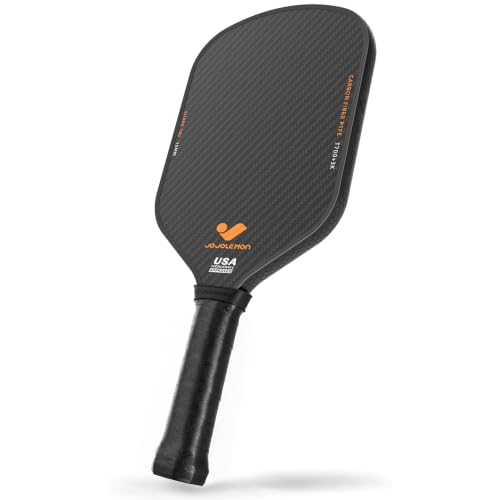
- OPTIMIZED PERFORMANCE DESIGN: JOJOLEMON pickleball paddles are expertly crafted to provide top-tier performance and comfort. Built with carbon fiber, this paddle delivers an
- PREMIUM TORAY T700SC CARBON FIBER: Introducing the Shark 100 Paddle, made from 3K raw carbon fiber for exceptional strength and stability. It’s perfect for intense play, giving
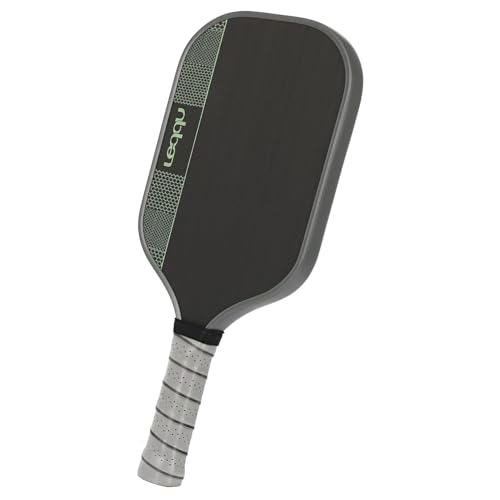
- PERFECT FOR BEGINNERS – This pickleball paddle features a 16mm raw carbon fiber face that offers a generous sweet spot and forgiving response, making it easy for new players to
- RAW CARBON FIBER FOR EXCELLENT FEEL – The uncoated raw carbon fiber surface provides exceptional ball feedback, helping beginners understand their contact point and develop
The Problem: Spec Sheets Are Written to Sell, Not to Inform
Look at any paddle listing and you'll see the same vocabulary recycled: explosive power, oversized sweet spot, tournament-level control. Those phrases are marketing. The specifications underneath them are the part you can actually compare across brands.
The challenge is that a listing mixes the two freely inside a single bullet. Leqqu's bullet, for example, pairs a hard number with a promise: it describes construction at 8oz with an oversized sweet spot, combining 16mm core stability with carbon fiber responsiveness [S4]. The 8oz and the 16mm are checkable. "Oversized sweet spot" is not — no listed source publishes a sweet-spot measurement in square inches, so treat it as a claim, not a spec.
Your job as a buyer is separating the numbers from the adjectives.
Step-by-Step: How to Read a Paddle Spec Sheet
1. Find the core thickness first
Core thickness is the single most consequential number on the sheet, and it is almost always printed in millimeters. All three paddles here list a 16mm core [S3][S4][S5]. That means, on paper, they sit in the same thickness class — the differences will come from what that core is made of and how the paddle is assembled.
If a listing does not state core thickness at all, that is a real gap. Walk away or ask the seller.
2. Identify the core material, not just the thickness
"16mm" alone is incomplete. Two 16mm cores can behave very differently depending on their chemistry.
- Polymer honeycomb. JOJOLEMON specifies a 16mm polypropylene honeycomb core with foam edges, which the listing credits with absorbing impact for smoother, more controlled shots [S3]. Polypropylene honeycomb is the mainstream construction in this category.
- Foam. ZALRYN specifies a 16mm foam core with EVA edge cushioning, which the listing says absorbs impact and reduces vibration to help ease wrist and elbow strain [S5]. A solid or foam-filled core is a different structure from an open honeycomb cell wall, and the manufacturer's framing here leans on vibration damping rather than pop.
- Graphite honeycomb. Leqqu's title says 16mm graphite honeycomb core [S4]. The supplied listing information does not name a honeycomb polymer for this paddle, so you know the geometry and the stated material but not a polymer grade.
3. Read the face material carefully
Face material governs surface texture and stiffness. Carbon fiber and fiberglass are the two you'll see most.
Carbon fiber vs fiberglass paddle face comes down to stiffness and how the surface grips the ball. Carbon fiber faces are the stiffer, more textured option and are the ones brands market for spin; fiberglass faces are typically pitched as softer and poppier. None of the supplied listings for these three paddles specify a fiberglass face, so this guide can only speak to what these carbon and aramid faces publish.
JOJOLEMON gets specific in a way most listings don't: 3K raw carbon fiber described as Toray T700SC, with a textured 4-directional carbon weave the brand says provides rigidity in all directions, enlarging the optimal striking area and minimizing dead spots [S3]. Naming a fiber grade and a weave count is more information than a generic "carbon fiber" bullet gives you.
Leqqu names T700 carbon fiber composite for its surface [S4]. ZALRYN goes a different direction entirely with a multi-directional woven Kevlar aramid fiber face, which the listing credits with toughness, impact resistance and abrasion resistance while its textured weave improves ball grip and energy transfer [S5]. Aramid is a genuinely different material family from carbon, and abrasion resistance is the property the manufacturer emphasizes.
One caution: "raw" carbon means unpainted, which brands associate with a grittier surface and more spin. The supplied listings do not publish a surface roughness measurement for any of these paddles, so spin claims stay claims.
4. Check for thermoformed construction
A thermoformed pickleball paddle is one where heat and pressure fuse the face, core and handle into a single unified structure rather than gluing separate parts together. ZALRYN describes exactly that process and says it helps reduce delamination risk [S5]. JOJOLEMON also describes a thermoformed single-piece design for enhanced durability and stability [S3]. The supplied listing information does not state whether the Leqqu paddle is thermoformed.
Delamination — the face separating from the core — is the failure mode thermoforming is meant to address. It is a construction argument, not a warranty.
5. Confirm USAPA approval if you plan to compete
USAPA approved meaning paddle: the paddle appears on the sanctioning body's approved equipment list and is legal for sanctioned tournament play. It is a compliance check on dimensions and surface, not a quality rating. A cheap approved paddle and an expensive approved paddle are equally legal.
ZALRYN's listing states the paddle is USAPA approved [S5]. JOJOLEMON says each Shark 100 paddle is built to USAPA standards and features a USAPA certification label [S3]. Note the wording difference — "built to standards with a label" is the seller's phrasing, and a seller's claim is not independent verification. If tournament legality matters to you, check the paddle model against the official approved list before you enter an event.
The supplied listing information does not state USAPA approval for the Leqqu paddle.
Recommended Products
> Three paddles that let you practice reading a spec sheet: > > - JOJOLEMON Pickleball Paddles Featuring a Raw Carbon Fiber Paddle Face — the most specific spec sheet of the three: named fiber grade, named core polymer, stated weight. > - Leqqu T700 Carbon Fiber Pickleball Paddle 16mm Graphite Honeycomb Core — a two-paddle bundle if you need a second paddle and accessories at once. > - ZALRYN 16mm Kevlar Aramid Fiber Foam Core Pickleball Paddle — the outlier on materials, with an aramid face and a foam core.
The Three Paddles, Read Closely
JOJOLEMON Pickleball Paddles Featuring a Raw Carbon Fiber Paddle Face and 16mm Power Polymer Core — Best for players who want a documented spec sheet
This one earns the pick on documentation: it is the only paddle here whose listing names both the fiber grade (3K raw Toray T700SC carbon) and the core polymer (16mm polypropylene honeycomb with foam edges) alongside a stated average weight of 8 ounces [S3]. If you want to compare like-for-like against other brands, this is the sheet that gives you the most fields to compare.
The listing positions the paddle for beginner to intermediate players focused on stable control and a comfortable hitting feel [S3], while a separate bullet says it suits players of all skill levels [S3]. The broader bullet covers all skill levels, while the more specific one calls out beginner to intermediate. It also specifies an extended handle the brand describes as ideal for two-handed backhand players, improving balance and leverage [S3]. If you hit a two-handed backhand, that is a concrete reason to shortlist it.
Strengths: named fiber grade and weave, named core polymer, stated 8oz average weight, thermoformed single-piece construction, USAPA certification label per the seller [S3].
Limitations to weigh: the extended handle that helps two-handed backhands typically comes at the cost of face length, which can matter if you rely on reach at the kitchen line. The supplied listing information does not state grip length, face dimensions or handle circumference, so you cannot confirm that trade-off from the published specs.
Leqqu T700 Carbon Fiber Pickleball Paddle 16mm Graphite Honeycomb Core — Best for buyers who need two paddles and accessories in one purchase
The distinguishing specification here is the bundle: Leqqu lists a 2-paddle set with indoor/outdoor balls, lead tapes for customizable weighting, and a carry bag [S4]. If you are outfitting a household or a doubles partnership, that is a genuinely different buying proposition from a single-paddle purchase.
The paddle itself lists T700 carbon fiber composite over a 16mm honeycomb core at 8oz, with a perforated sweat-absorbent cushioned handle and a reinforced edge guard [S4]. Lead tapes in the box are worth noting — they let you add weight to the head or handle to shift swing weight yourself.
Strengths: two paddles plus balls, lead tapes and a bag in one set; T700 carbon face; stated 8oz; edge guard [S4].
Limitations to weigh: the supplied listing information does not state whether this paddle is thermoformed, does not name a honeycomb polymer beyond the stated graphite honeycomb core, and does not state USAPA approval. If sanctioned tournament play is your goal, verify approval before buying. The listing also describes it as suiting beginner through advanced players [S4], which is broad enough that it doesn't narrow your choice much.
ZALRYN 16mm Kevlar Aramid Fiber Foam Core Pickleball Paddle — Best for competitive players prioritizing durability and vibration damping
This is the materials outlier, and that's the point. It pairs a woven Kevlar aramid fiber face with a 16mm foam core and thermoformed unibody construction, and it is the only one of the three whose listing explicitly ties the core to easing wrist and elbow strain [S5]. Aramid's published property here is toughness and abrasion resistance [S5] — a different argument than carbon's stiffness-and-spin pitch.
ZALRYN also states the paddle is USAPA approved and positions it for advanced and competitive players who want explosive power and lasting durability [S5]. The thermoforming bullet specifically claims reduced delamination risk from fusing face, core and handle into one structure [S5]. The set includes the paddle, 2 grip tapes and gift box packaging, with 1 year of product support [S5].
Strengths: aramid face with stated abrasion resistance, foam core framed around vibration reduction, thermoformed unibody, USAPA approved per the listing, 1-year product support [S5].
Limitations to weigh: the supplied listing information does not state this paddle's weight. Weight drives swing speed and arm load, so you would need to confirm that number with the seller. The listing also aims the paddle at advanced and competitive players [S5], so newer players may find it more paddle than they need.
Spec Comparison
| Spec | JOJOLEMON Pickleball Paddles Featuring a Raw Carbon Fiber Paddle Face and 16mm Power Polymer Core | Leqqu T700 Carbon Fiber Pickleball Paddle 16mm Graphite Honeycomb Core | ZALRYN 16mm Kevlar Aramid Fiber Foam Core Pickleball Paddle |
|---|---|---|---|
| Core | 16mm polypropylene honeycomb, foam edges [S3] | 16mm honeycomb [S4] | 16mm foam, EVA edge cushioning [S5] |
| Face | 3K raw Toray T700SC carbon, 4-directional weave [S3] | T700 carbon fiber composite [S4] | Woven Kevlar aramid fiber, multi-directional [S5] |
| Stated weight | 8 oz average [S3] | 8 oz [S4] | Not stated in supplied listing |
| Thermoformed | Yes, single-piece [S3] | Not stated in supplied listing | Yes, unibody [S5] |
| USAPA | Built to USAPA standards with certification label per seller [S3] | Not stated in supplied listing | USAPA approved per listing [S5] |
| In the box | Not stated in supplied listing | 2 paddles, balls, lead tapes, bag [S4] | Paddle, 2 grip tapes, gift box [S5] |
Tips for Best Results
- Compare core thickness only against the same core material. A 16mm foam core and a 16mm polypropylene honeycomb core share a number, not a structure.
- Treat weight as a first-order spec. Two of these publish 8oz [S3][S4]; the third does not publish one in the supplied listing. Missing is missing — not light.
- Use lead tape if your paddle came with it. The Leqqu set includes lead tapes for customizable weighting [S4], which is the cheapest way to change how a paddle swings without buying another one.
- Verify tournament legality on the official list, not on the listing bullet, before you register for a sanctioned event.
- Match the handle to your backhand. An extended handle is specifically pitched at two-handed backhand players [S3]; if you hit one-handed, that length buys you less.
Common Mistakes to Avoid
- Reading "16mm" as a quality tier. It is a dimension. It tells you about feel, not build quality.
- Assuming a missing spec means a bad spec. When a listing doesn't publish thermoforming or weight, that's an information gap you should close with the seller — not evidence the paddle lacks the feature.
- Treating a seller's USAPA claim as verification. A certification label described in a bullet is the seller's statement [S3]. The official approved list is the authority.
- Buying spin claims without a texture spec. Surface roughness is regulated and measurable, but none of these supplied listings publish a roughness figure.
- Ignoring the bundle math. A two-paddle set [S4] and a single paddle are not the same purchase, however similar the headline specs look.
How We Research
This website does not physically test, weigh, swing or measure equipment, and runs no lab. For this guide, paddle specifications were drawn from Amazon Creators API verified product records and the products' own listing feature bullets, all retrieved on 2026-09-06 [S3][S4][S5]. Where a listing publishes a figure, it is attributed to the manufacturer or the listing. Where a field is absent, this page says so rather than estimating. For general consumer product safety and purchasing protections, CPSC [S1] and USA.gov consumer protection [S2] are the authoritative references.
Final Verdict
If you want the paddle whose published specifications you can actually audit, the JOJOLEMON Pickleball Paddles Featuring a Raw Carbon Fiber Paddle Face and 16mm Power Polymer Core is the one — it names the fiber grade (3K raw Toray T700SC), the core polymer (16mm polypropylene honeycomb) and an 8oz average weight in a single listing [S3], which is more disclosure than the others provide, and its extended handle is aimed squarely at two-handed backhand players [S3].
If your priority is durability and vibration damping and you play competitively, the ZALRYN 16mm Kevlar Aramid Fiber Foam Core Pickleball Paddle is the more interesting spec sheet: aramid face, 16mm foam core, thermoformed unibody, and stated USAPA approval [S5]. Just know the supplied listing information does not state its weight.
And if you need two paddles plus accessories in one go, the Leqqu T700 Carbon Fiber Pickleball Paddle 16mm Graphite Honeycomb Core set covers that with balls, lead tapes and a bag [S4] — verify tournament approval separately if you compete.
No one here has swung any of them. What this comparison gives you is the ability to read the sheet.
Related Resources
- Choosing pickleball shoes for outdoor courts
- Setting up a backyard pickleball court
- Paddle grip size and overgrip basics
Sources & Methodology
Nothing on this page came from a court, a scale or a lab bench — this website did not physically or laboratory-test any of these paddles, and does not run product research at all. What informed it was a line-by-line read of Amazon Creators API verified product records and each paddle's published listing feature bullets, retrieved 2026-09-06, with every figure kept attached to whoever published it and every absent field flagged as absent rather than guessed. For a category where core thickness, face material and construction method are all printed on the listing, that reading is enough to tell you which paddles are documented, which are vague, and which one matches the problem you are trying to solve — but it cannot tell you how any of them feels in a hand, and this page does not pretend otherwise.